





This comprehensive guide breaks down the core principles and operational steps required for businesses to establish and maintain state-level tax compliance across the United States. While federal registration focuses primarily on securing an EIN, state-level obligations form the foundation of day-to-day legal and financial operations.
Navigating the complex regulatory environment of state tax registration is a fundamental responsibility for every business owner. While federal requirements like obtainingan EIN guide are often emphasized, the statelevel tax framework is wherethe majority ofoperational liabilities originate. Understanding these rules is essential formaintainingcompliance and ensuring your businessoperateswithin the legal parameters of itsjurisdiction. Whether you are ready to start a business or are managing an established entity, knowing when and how to register for state taxes is a foundational skill that defines yourlongtermsuccess.
The Foundation of State Tax Compliance
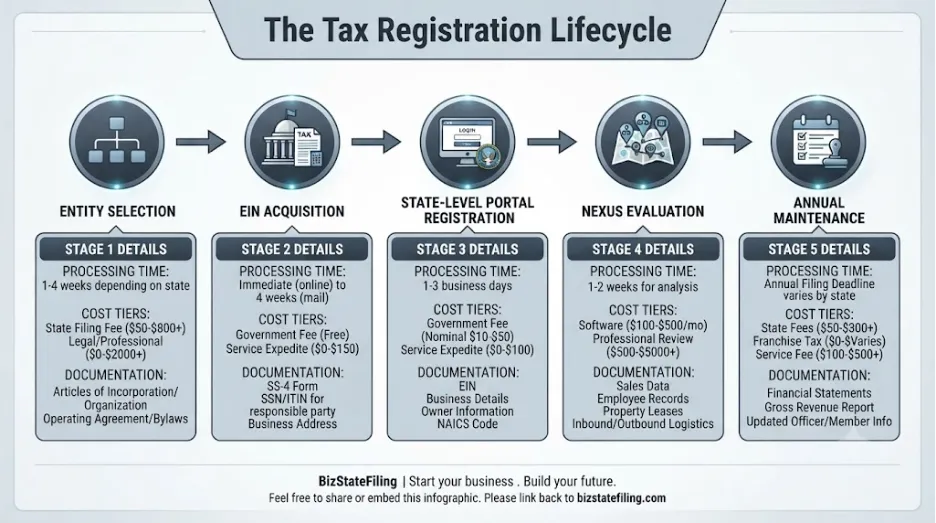
State tax registration involvesidentifyingthe specific requirements imposed by the state where your businessoperates. These rules vary significantly depending on the nature of your business activities, your corporate structure, and the presence youmaintainin any given state. For those looking to understand the core steps involved, a business compliance checklist serveas an invaluable tool to organize your administrative duties.
The process of choosing the right structure is the first step in this journey. If you are comparing the benefits of an llc vs s corp , you will find that the choice impacts not only your federal tax treatment but also your statelevel reporting obligations. Before formalizing your entity, it is wise to consult a startup cost calculator to understand the fiscal impact of these filings on yourinitialbudget. Once you haveidentifiedthe right path, you can begin the formal process of registration.
|
Entity Type |
Tax Treatment |
Filing Complexity |
Primary State Focus |
Operational Flexibility |
|
Sole Proprietorship |
Passthrough |
Low |
Local licenses |
High |
|
Partnership |
Passthrough |
Moderate |
State reports |
Moderate |
|
LLC |
Flexible |
Moderate |
State specific filing |
High |
|
S Corporation |
Restricted |
High |
Payroll returns |
Low |
|
C Corporation |
Double Tax |
Very High |
Corporate income |
Moderate |
|
Nonprofit |
Tax Exempt |
High |
State oversight |
Low |
Understanding Nexus and State Obligations
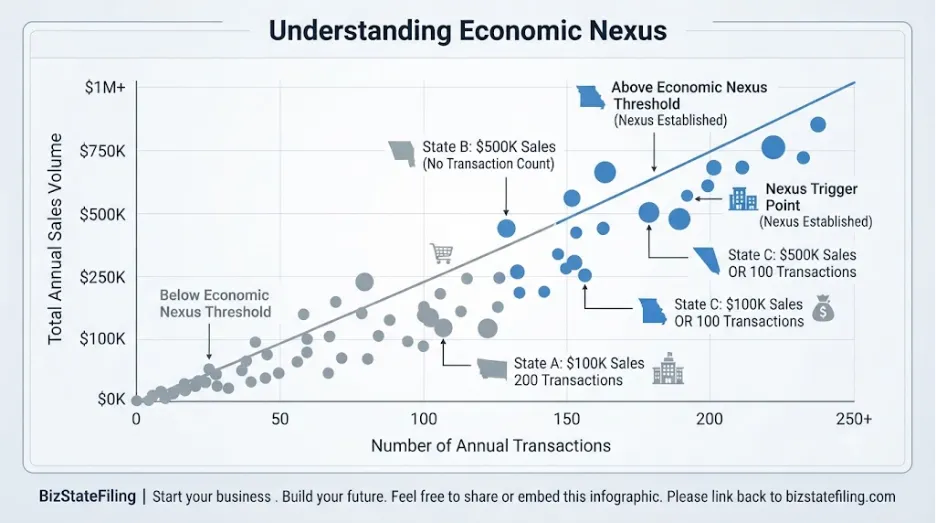
The concept of nexus isperhaps themost criticalcomponentof yourstate'stax strategy. Nexus defines the threshold at which your businessis required tocollect and remit taxes within a state. While physical presenceremainsa traditional trigger, the landscape has shifted to include economic nexus. This means that even without an office or employees, exceeding specific sales volumes or transaction counts can create a legal requirement toregistertaxes in that state.
Many business owners find it helpful tomonitorthese developments by reviewing state filing deadlines regularly. If your business is scaling rapidly, you may alsobenefitfrom professional guidance to ensure that yourmultistatecomplianceremainsrobust. When you are ready to expand, ensuring you have the correct documentation for your entity is a priority. For example, understanding start llc processes can set the stage for a professional approach to your administrative requirements.
Entity Types and Tax Registration
The entity type you choose for your business dictates the state taxes you are liable for. The registration requirements for a us sole prop differ significantly from those of a us c corp . This is why it is vital to research the specific implications of your chosen structure. Many entrepreneurs choose to review entity types in depth beforecommittinga final decision.
|
Comparison Point |
LLC |
C Corporation |
S Corporation |
Sole Proprietorship |
|
Liability Protection |
High |
High |
High |
None |
|
Tax Structure |
Passthrough |
Corporate Tax |
Passthrough |
Individual Tax |
|
Management |
Flexible |
Formal |
Formal |
Simple |
|
Reporting Burden |
Moderate |
Heavy |
Heavy |
Light |
|
Registration Fee |
Varies |
Varies |
Varies |
Minimal |
When you decide on your entity, you must also obtain your federal identification. After federal registration, you mustpivotyour statelevel filings. Failure to keep your corporate record current can lead to administrative dissolution, which is why businesses often look for specific guidance on how to manage their legal standing through business guides .
Industry Specific Tax Requirements
Tax obligations are not just tied to your location; they are also heavily influenced by your industry. A firm in the restaurant business has different inventory and sales tax challenges compared to a business in the trucking business . Evenservicebasedfirms, such as a landscaping business or a cleaning business , must ensure they are collecting and remitting the correct taxes based on local ordinances.
|
Industry |
Primary Tax Focus |
Compliance Requirement |
Oversight Agency |
|
Accounting Services |
Professional licensure |
Multistate nexus |
State Board |
|
Food Franchises |
Sales tax on food |
Health permits |
Dept of Health |
|
Healthcare Services |
Payroll and excise |
HIPAA compliance |
Dept of Health |
|
Real Estate |
Property transfer |
Agent registration |
Real Estate Comm |
|
Construction |
Local permits |
Projectbased reporting |
Labor Dept |
|
Ecommerce |
Sales and Use tax |
Economic nexus monitoring |
Revenue Dept |
|
Consulting |
Local gross receipts |
Business license |
City Clerk |
|
Beauty Salon |
Equipment tax |
Retail permits |
State Board |
Industry leaders often emphasize the importance of having a clear strategy for your specific sector. Whether you are managing a healthcare business or a consulting business , understanding the nexus triggers unique to your field is vital. If you are looking for more specific information, you can explore the full industries database for comprehensive data on your operational sector.
Managing Ongoing State Compliance
Once you have successfully registered, the work is far from over. Compliance is an ongoing process that requires consistent monitoring of your obligations. Every state requires periodic reporting to verify that your business is still active and in good standing. For businessesoperatingin highgrowthjurisdictions, staying on top of these requirements is essential.
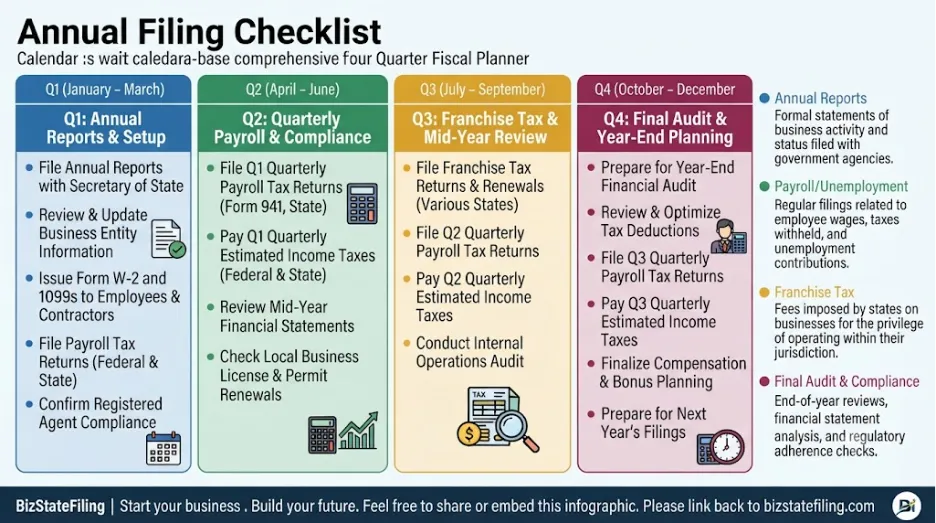
For instance, companiesoperatingin California must navigate specific requirements for a california annual report , while those in Texas or Florida have their own distinct workflows, such as the florida annual report or the texas annual report . A dedicated compliance calendar can help you avoid the common pitfalls of late filings and the resulting penalties. By treating compliance as a proactive function rather than a reactive task, you minimize the risk of legal or financial complications.
The Role of Registered Agents
A registered agent is an individual or companydesignatedto receive legal documents and government notices on behalf of your business. Most states mandate that every registered entity mustmaintainan agent within that state. This is a crucialcomponentof your business license requirements , asfailing to havean agent can lead to a loss of your legal standing.
When you are planning your operational structure, ensure thatyou registered agent requirements are met from day one. This provides a single, reliable point of contact for the state and ensures that timesensitive documents are addressed promptly. Many business ownersutilizethirdparty services to handle these responsibilities, allowing them to focus on core growth activities.
Technology and Data in Tax Compliance
In the modern digital economy, manual tracking is rarely sufficient. Businesses that grow across multiplejurisdictionsoftenleveragedigital tools tomaintainaccuratedata. This includes using a bulk address cleaner to ensure your nexus calculations are based on valid location data. Accuracy here is critical, as incorrect data can lead to underpayment of taxes andsubsequentaudits.
Beyond basic accuracy, there is alsoaneed for ongoing education. If you are preparing for longterm growth, you may want to look into business formation to understand the nuances of modern corporate governance. Maintaining a high standard of recordkeeping is the best defense against regulatory scrutiny.
Strategic Expansion and Foreign Qualification
As your business grows, you may decide to expand beyond your home state. This process is known as foreign qualification, where you register your existing entity tooperatein another state. This isnot the same asforming a new company, but it doescarry outits own set of registration requirements, including filing fees and the appointment of a registered agent in the newjurisdiction.
|
Expansion Strategy |
Primary Benefit |
Risk Factor |
Administrative Task |
|
Foreign Qualification |
Legal presence |
Increased tax filings |
Agent appointment |
|
Subsidiary Formation |
Asset protection |
Complexity of management |
Federal registration |
|
Franchise Expansion |
Established brand |
High upfront cost |
Contractual compliance |
|
Digital Presence |
Market reach |
Nexus trigger risk |
Sales tax collection |
It is important to understand the top states for business before deciding where to expand. Certain states offer more favorable tax environments or simpler registration processes. By conducting thorough research, you can choose a location that aligns with yourlongtermexpansion goals.
Navigating Regulatory Changes
Tax laws are not static. Legislative changes occurfrequently, and business ownersare responsible forstaying informed about any adjustments thatimpacttheir tax liabilities. Relying on outdated information is a common cause ofnoncompliance. Subscribing to regular updates from your state revenue department is a simple yet effective way to remain current.
If you are a new business owner, you might also find value in joining local expos and events where you can network with other professionals and learn about changes in the local regulatory landscape. Engaging with the business community isa great wayto stay ahead of the curve.
Conclusion
State tax registration is a fundamental aspect ofoperatinga business in the United States. By understanding your nexus, selecting the right entity type, andmaintaininga rigorous compliance calendar, you can ensure that your businessremainsin good standing. While the process can be complex, breaking it down into manageable steps makes it entirely achievable for any dedicated entrepreneur.
Frequently Asked Questions
1. What is the difference between state and federal tax registration?
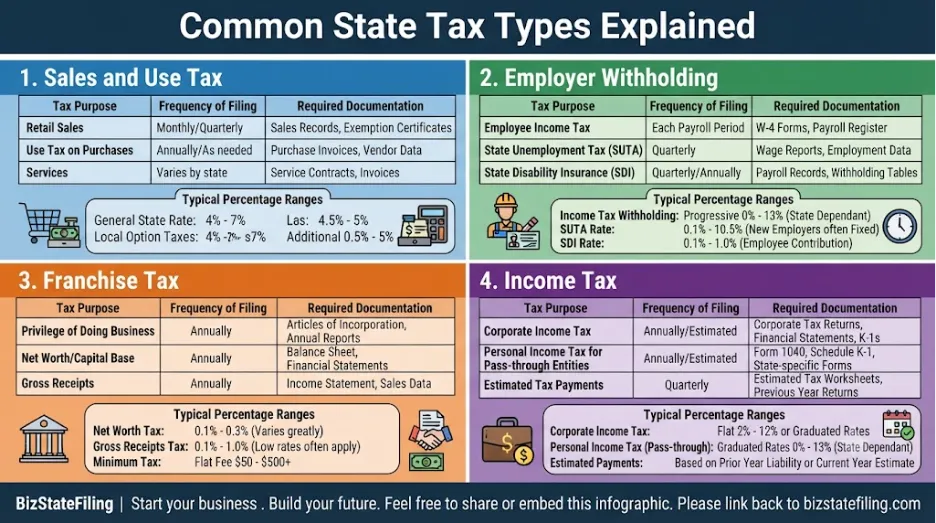
Federal registration usually involves the IRS and obtaining an EIN, while state registration is handled by individual state revenue departments for taxes like sales, payroll, and franchise taxes.
2. Does every business need to register for state taxes?
If you haveestablishednexus in a state, whether through a physical office or by meeting economic thresholds, yougenerally mustregistertaxes in thatjurisdiction.
3. What is an annual report?
An annual report is a periodic filing required by most states to keep your business records current and ensure your entityremainsin good standing.
4. Can I change my business entity type after I have registered?
Yes, you can change your entity type, but it often requires new filings and potential tax implications that should be discussed with a professional.
5. What happens if I miss a state tax filing deadline?
Missing a deadline can result in late fees, interest charges, and in severe cases, the suspension or administrative dissolution of your business entity.
6. Is a registered agent the same as an office address?
No. While an office address is your place ofoperation, a registered agent is a person or service authorized to accept legal and official correspondence on your behalf.
7. How do Idetermineif I haveeconomicnexus?
Economic nexus isdeterminedby your sales volume or number of transactions within a state, which vary byjurisdiction. You must check the specific thresholds for each state where youoperate.
8. Should I handle taxregistrationor hire a professional?
While you can handle the process yourself, many businesses prefer hiring a professional service to ensure accuracy, especially whenoperatingacross multiple states with different requirements.
9. Do states have different tax forms for different industries?
Yes. Depending on your industry, such as real estate or restaurant services, you may have unique reporting requirements or excise taxes to account for.
10. Where can I find specific state filing instructions?
You should visit the official Department of Revenue website for each state in which you are conductingbusiness orutilizea reputable business filing service for centralized resources.
 Perplexity
 Claude
 Grok
Grok