





For any entrepreneur moving beyond the initial concept phase, the distinction between a registered agent and a business address is one of the most critical operational lessons to learn. These two entities are often confused, yet they serve vastly different legal and administrative purposes. Failing to understand how they interact can lead to privacy breaches, legal complications, and regulatory penalties. This article provides a deep dive into why these address classifications exist and how they should be managed for maximum efficiency and security.
A registered agent is an individual or professional service officially designated to receive service of process, legal notices, and government correspondence on behalf of a business, ensuring compliance with state due process requirements. In contrast, a business address refers to the actual physical or mailing location where a company conducts its daily operations, handles general customer inquiries, and manages standard commercial mail. While every business entity is legally required to maintain a registered agent with a physical street address in each state of operation, a business address is primarily used for operational and marketing purposes and does not inherently satisfy state legal representation mandates. Utilizing a professional registered agent service also protects privacy by keeping personal or home addresses off public records, whereas a standard business address is often publicly visible.
The Legal Definition of a Registered Agent
A registered agent is an individual or a company designated to receive official legal documents on behalf of your business. State statutes require every limited liability of the company, corporation, and partnership to maintain this role. The primary purpose of a registered agent is to provide a consistent, physical point of contact for the state and the court system. When someone sues your company, the process server will look for the registered agent at their designated location to deliver the legal summons.
If your business is in the process to start a business, you are required to list a registered agent in your formation documents. The agent acts as the official bridge between your company and the regulatory authorities. Without a valid agent, the state has no assurance that you are reachable for time sensitive notifications, which can result in the administrative dissolution of your business entity.
The Role of a Business Address
A business address is the primary physical or virtual location where your daily operations occur. This address is used for non legal correspondence, such as client mail, vendor invoices, banking statements, and general business communications. Unlike the registered agent, there is no strict state mandated requirement for where your business address is located, although it must be a valid location where you receive regular mail.
Many business owners believe they can use their home address for both functions. While this is technically possible in some jurisdictions, it is rarely a sound strategy. A business address is the face of your company to the public, while the registered agent is a silent, specialized guardrail for your legal standing.
Privacy and Public Record Implications
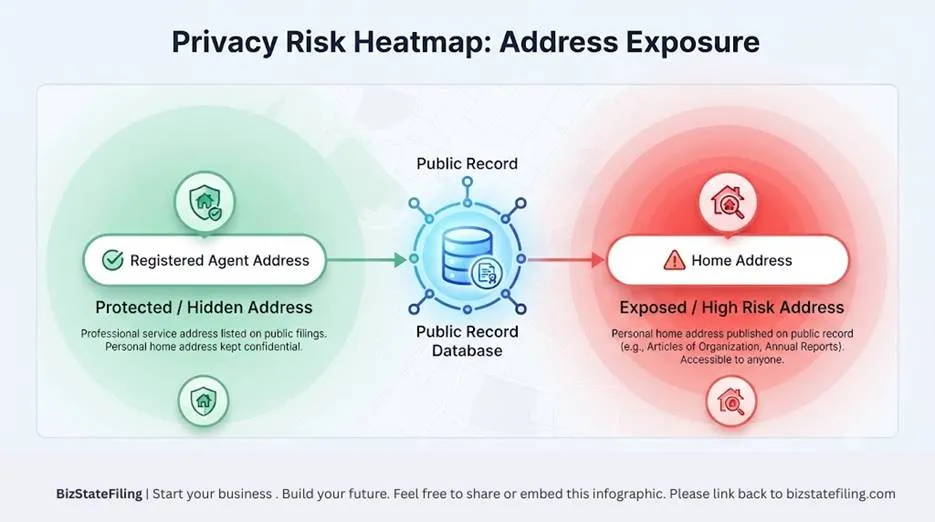
One of the most significant differences between these two is their visibility in the public record. In most states, the registered agent information is fully accessible to the public. If you act as your own registered agent and use your home address, your private residence becomes a matter of public records. Anyone searching for your business entity can easily find where you live.
This vulnerability creates a genuine security concern. Using a professional service provider to maintain your registered agent status ensures that their address is listed on public filings rather than your private residence. When managing these public facing aspects of your company, it is essential to ensure that your internal systems are clean, and your sensitive data is protected. You can use a professional text redactor to clean internal documents that might otherwise leak sensitive data if they were accidentally uploaded to a public repository.
Operational Necessity and Availability
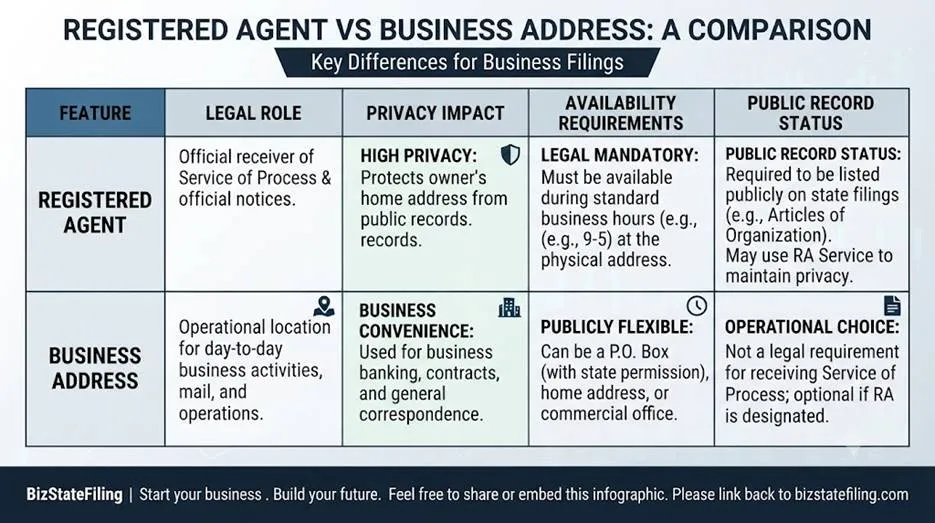
The statutory requirement for a registered agent dictates that they must be available at the address during all standard business hours. This availability is intended for the benefit of process servers and government officials. If you are your own registered agent and you travel, go on vacation, or simply step out for a meeting during the day, you risk missing legal notice.
Missing a legal notice can lead to a default judgment against your company. In contrast, your business address does not need to be staffed at all times. It is a convenience location for your day to day work, not a regulatory checkpoint. Managing these disparate requirements requires a structured approach to your daily operations. Many high performing executives use a time blocker to segment their administrative duties, ensuring that legal and operational mail is reviewed at distinct, dedicated times rather than managed in a chaotic, reactive manner.
Tabular Comparison of Address Functions
To understand the core differences between these two roles, consider the specific obligations and operational requirements that govern each.
|
Feature |
Registered Agent Address |
Business Operational Address |
|
Primary Purpose |
Receiving legal process and state notices |
Daily business mail and operations |
|
Public Record |
Usually required to be public |
Optional depending on business needs |
|
Availability |
Required during standard business hours |
No specific availability requirement |
|
Regulatory Status |
Mandatory legal requirement |
Operational choice |
|
Document Type |
Lawsuits, tax notices, subpoenas |
Invoices, general mail, marketing |
|
Frequency of Change |
Requires formal state filing |
Easy to change at your discretion |
|
Serviceability |
Must be a physical address |
Can be a PO Box or virtual office |
The Dangers of Combining Addresses
When you use the same address for both roles, you increase your risk profile significantly. Many business owners initially attempt to keep costs low by using their home address for everything. While this saves money in the short term, it creates administrative debt. If your business grows or if you find it necessary to scale your business formation, you will quickly find that your private home address is now entrenched in every legal filing, government database, and public directory associated with your entity.
Furthermore, if you are looking to sell your company, a messy compliance history where your home address is used for everything can lower the perceived professionalism of your organization. Potential buyers look for a clear separation between personal assets and business operations.
Risk Management and Financial Impact
The financial implications of mixing these addresses are unpredictable. If you miss a lawsuit notice sent to your registered agent address because it was buried under junk mail at your business or home address, the costs of a default judgment will far outweigh the savings you achieved by skipping a professional service.
When you perform your annual analysis of operational costs, you should evaluate the risk of compliance failures as part of your financial health. You can use specialized tools to break even on your service expenses to determine if the cost of a professional registered agent service is a justifiable investment.
|
Risk Category |
Registered Agent Failure |
Business Address Failure |
|
Legal Standing |
High risk of administrative dissolution |
Low risk, mostly operational delay |
|
Privacy |
High risk of public address exposure |
Moderate risk of customer spam |
|
Financial Penalty |
High potential for default judgments |
Low potential for late fees |
|
Reputation |
Severe impact on business credibility |
Minimal impact on day to day operations |
|
Audit Trail |
Often chaotic without a system |
Generally managed through internal mail |
Geographic and Industry Variations
The importance of this distinction often changes depending on where you operate and what industry you serve. For instance, the compliance landscape for a business in the health and senior care sector is significantly different from that of a retail startup. These industries require deep knowledge of both operational and regulatory environments.
If you are evaluating the best locations to establish your presence, it is vital to research the economic climate of the area. Using data to identify the best cities for business can help you decide where to base your operations, but your registered agent must remain in the state where you are registered. If you are doing business in multiple states, you need a registered agent in every one of them, whereas your business address can technically remain in your headquarters location.
Ensuring Compliance Across Borders
When you expand your business into new jurisdictions, the complexity of managing these two addresses grows exponentially. You must maintain a registered agent in every state where you are foreign qualified. This is a common hurdle for businesses utilizing a franchise guide to expand their footprint nationally.
If you are managing compliance across state lines, the digital component of your registered agent service becomes your lifeline. You should receive digital copies of any legal documents, not just physical mail. This centralization of legal notices allows you to maintain control even when you are not physically present in the state of registration.
Analyzing the Operational Impact of Address Mismanagement
Many businesses suffer from poor organizational health simply because they cannot distinguish between the types of mail they receive. When the legal process is mixed with marketing flyers, the probability of human error increases. An effective business guides review can illustrate how top performing companies maintain this separation.
It is important to remember that the government does not care about your operational convenience. They care about the service. If they serve papers to your registered agent, they have met their legal obligation to notify you. If you never see those papers because your registered agent address was effectively your busy, cluttered business mailbox, that is your liability, not the states.
Data Security and Document Handling
Handling legal documents requires a higher level of care than handling standard business mail. These documents are often confidential, sensitive, and time sensitive. If you receive these at your general business address, your employees or visitors might inadvertently see them.
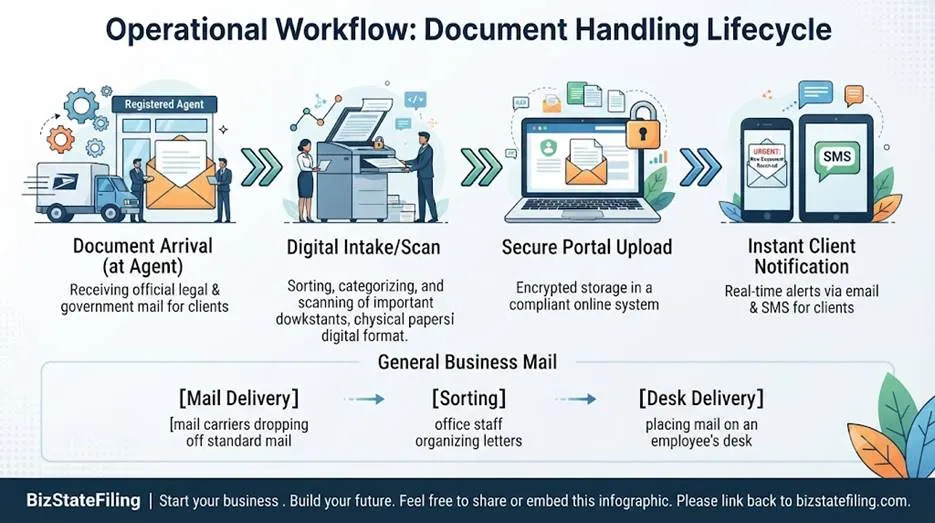
This creates a security and privacy risk. Professional registered agent services are built to handle these documents securely. They process them through an internal system, digitize them, and upload them to a secure portal. If you are handling sensitive internal documents on your own, ensure you follow a strict HIPAA guide or equivalent data security standards for your industry. Protecting your legal notices is just as important as protecting your intellectual property.
Strategic Decision Making
As your company matures, your administrative setup should mature with it. Early stage businesses often start with a consolidated address setup, but scaling requires separation. If you find your business is increasingly reliant on local operational infrastructure, it is time to pivot toward a professional registered agent and a separate, dedicated business address.
This evolution is part of building a robust organization. Whether you are dealing with assisted living logistics or high tech manufacturing, the separation of legal representation from operational mail is a hallmark of an established, low risk business entity.
Frequently Asked Questions
1. Is a registered agent the same as a business address?
No, they are distinct entities. A registered agent is a legal requirement for receiving service of process, while a business address is the location of your operational activities.
2. Can I use my home address for both?
You can technically do this in many states, but it is highly discouraged. Using your home address for both functions compromises your privacy and creates a public record of your residence.
3. Does the registered agent need to be at my business address?
No. In fact, it is often better if they are not. A professional registered agent is typically an entity that provides a specific, legally compliant address for legal notices.
4. What happens if I miss a legal notice sent to my business address?
If the notice was meant for the registered agent and you did not have a proper agent setup, you may be held liable for a default judgment even if you claim you never received the notice.
5. How do I change my registered agent address?
You must file a formal notice of change with the Secretary of State or the relevant government body in the jurisdiction where your business is formed.
6. Can I use a PO Box as my registered agent address?
No. State laws almost universally require a physical street address for a registered agent because a process server must be able to physically approach the location to deliver documents.
7. Does a virtual office work as a registered agent?
Usually, no. Most states require a physical presence. While some virtual offices offer registered agent services, you must ensure they meet the specific legal definitions provided by the state.
8. Why do I need a separate business address?
A separate business address allows you to manage daily operations, vendor relations, and customer mail without confusing these documents with critical, time sensitive legal filings.
9. Are there costs involved in maintaining both?
Yes, but they are different. A registered agent has an annual fee for compliance, while a business address might involve rent, virtual mailbox fees, or other operational expenses.
10. Does a registered agent provide legal advice?
No, a registered agent is strictly responsible for receiving and forwarding legal documents. They do not provide legal counsel, nor do they represent you in court.
 Perplexity
 Claude
 Grok
Grok