




This guide provides entrepreneurs and business owners with a clear roadmap for navigating New York’s regulatory landscape. It outlines state-level registrations, city and county permits, professional licensing, and tax obligations required to operate legally in New York.
Launching a commercial enterprise in the State of New York is ahighstakesventure that demands a precise understanding of the regulatory environment. New York does notmaintaina single,allencompassingbusiness license. Instead, the stateoperatesunder a decentralized system where compliance obligations are dictated by a combination of state statutes, county health and safety codes, and local municipal ordinances. Successfully navigating this landscape is the primary hurdle for any entrepreneur planning to start a business in USA .
The Regulatory Framework of New York Commerce
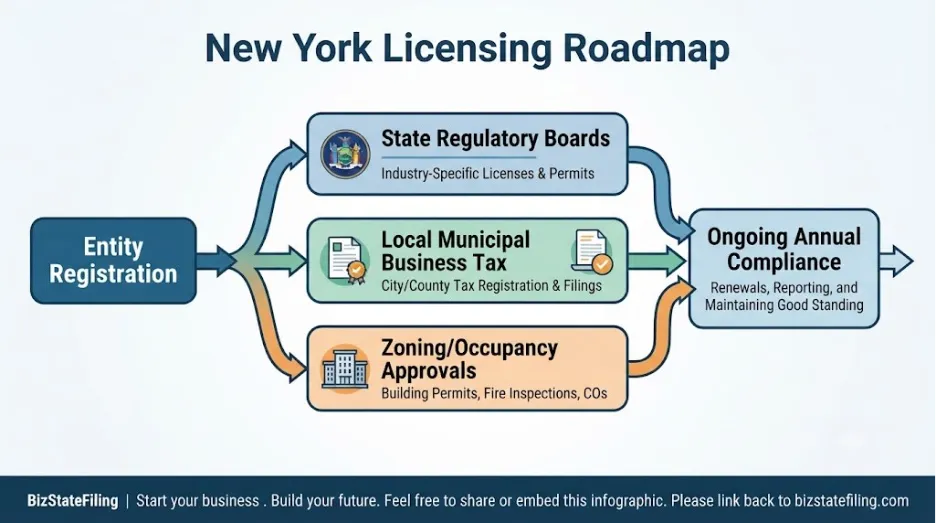
In New York, your journey toward operational authority begins after you have formalized your entity with the Department of State. While legal registrationestablishesyour company as a corporate entity, it does not grant the right to engage in commercial transactions oroperatea physical storefront. Most enterprises require specific permits tailored to their location and business activity.
For many founders, the complexity of state and local paperwork can be a barrier to efficiency. Utilizing a professional business registration platform helps youmaintaina centralized record of your filing requirements, tax registrations, and license renewal dates. Without a robust tracking system, businesses risk missing critical deadlines, which can lead to administrative fines or the involuntary suspension of corporate status. Understanding these requirements early is part of a successful business formation strategy.
Analyzing Local Market Requirements
Beforefinalizingyour commercial site, you must perform a thorough small business location analysis . New York is geographically and economically diverse, and local ordinances vary significantly between boroughs and upstate counties. Municipalities often enforce their own local tax receipts, which function as a mandatory permit to conduct business within city limits.
Beyond the tax receipt, zoningremainsthe most common point of friction for new enterprises. If you are looking to buy a business for sale , you must verify that the current physical location has a valid certificate of occupancy that covers your intended use. If the building is not zoned for your specific business model, you will face costly delays. You may need to utilize relocation intelligence tools to factor in these costs if you need to renovate or upgrade a facility to meet municipal code standards.
IndustrySpecific Compliance and Oversight
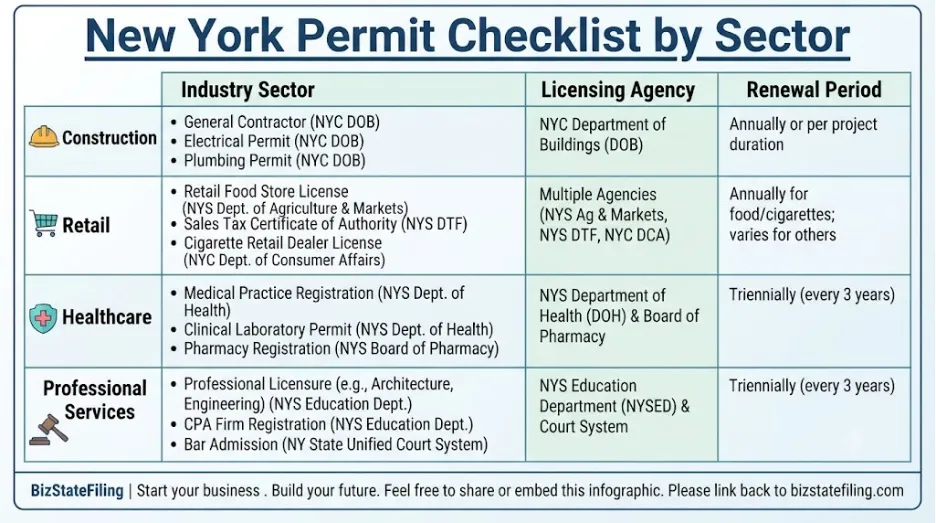
Your regulatory burden islargely determinedby your industry sector. A retail boutique in Manhattan faces different zoning and tax requirements than a healthcare clinic in Buffalo or a construction firm in Albany. The following table provides a breakdown of the regulatory demands across various major sectors in New York.
|
Industry Sector |
Primary Regulatory Agency |
Typical Compliance Frequency |
Core Requirement Focus |
|
Professional Services |
Dept of Education |
Biennial |
Technical competency |
|
Construction and Trades |
Dept of Buildings |
Annual |
Safety and insurance |
|
Retail and Ecommerce |
Dept of Taxation |
Permanent |
Sales tax collection |
|
Hospitality and Tourism |
Dept of Health |
Annual |
Sanitation and safety |
|
Healthcare and Clinics |
Dept of Health |
Annual |
Patient welfare |
|
Real Estate Brokerage |
Dept of State |
Biennial |
Fiduciary standards |
|
Child Care Services |
Office of Children and Family |
Annual |
Background screening |
|
Cosmetic Services |
Dept of State |
Biennial |
Sanitation standards |
|
Transportation Services |
Dept of Transportation |
Annual |
Commercial permits |
|
Financial Consulting |
Dept of Financial Services |
Annual |
Fiscal transparency |
Financial Obligations and Operational Costs
Compliance costs are a recurring operational expense, not aonetimestartup fee. Between city business taxes,statereports, and industryspecific certifications, the overhead can besubstantial. Successful entrepreneurs often use a subscription analyzer and burn rate tool to keep track of these recurring expenses.
Furthermore, if you are looking to find a business for sale , you must treat the transfer of licenses with caution. A permit is rarely automatically transferable between owners. You willlikely needtoreapplyfor many licenses under your new entity. This process should be factored into your valuation process to ensure you do not overpay an entity that faces immediate regulatory hurdles.
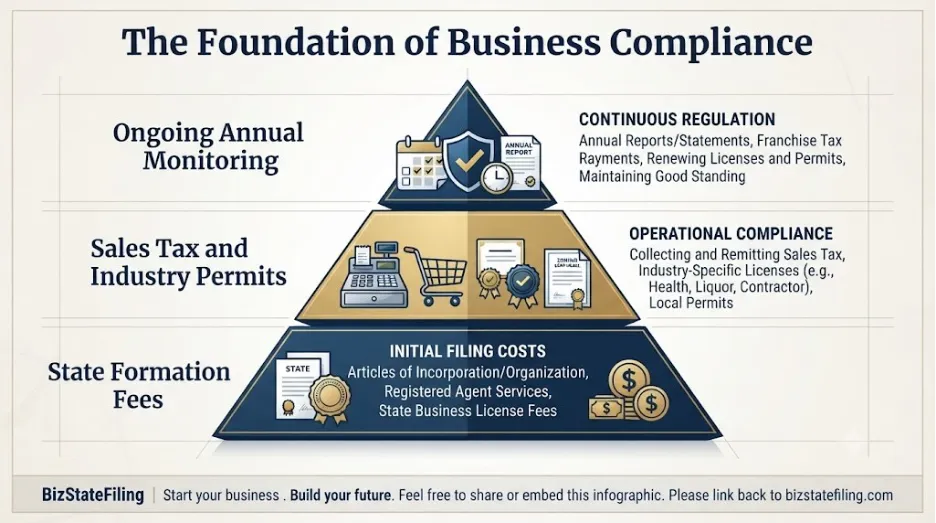
Navigating the Compliance Lifecycle
Managing ongoing compliance requires a disciplined approach to documentation and scheduling. Many entrepreneursfail torealize that initial licensing is merely the first chapter. Regulatory agencies in New York often update their mandates, and businesses are expected to stay current with these changes. Whether it is a change in the minimum wage, new environmental regulations, or revised fire safety codes,failing to adaptcan result in citations.
To streamline this, founders shouldleveragea compliance calendar to map out every renewal deadline for the upcoming year. This prevents the panic associated with loomingexpirationdates andhelpsmaintaina professional reputation with municipal authorities.
The Role of Data Integrity and Compliance Hygiene
Compliance is about data integrity as much as it is about holding paper permits. State agencies use the information provided during registration to send out critical updates and tax alerts. If your contact information is inaccurate, you risk missing important filings. Using a bulk address cleaner ensures that your records are consistent across all government portals.
For businesses that store sensitive data,maintainingcompliance also involves privacy standards. If you handle client information or process payments, your internal workflows should be regularly audited. Utilizing a text redactor helpprotect sensitive information from accidental disclosure, which is a keycomponentof modern business security.
Strategies for Expansion and Scaling
As your business grows, your licensing needs will expand. Moving froma single locationto a regional operation means you must nowcomply withthe ordinances of every municipality where you have a footprint. If you are looking to explore franchise opportunities as a way to scale, remember that franchisors often provide a blueprint for compliance.
Even with a proven model, youare responsible forlocal execution. You might need to calculate business breakeven point after accounting for the licensing costs of each new location. A common strategy for efficient management is todesignatea specific team member tomonitorall upcoming renewals. Using a time blocker allows you to set recurring alerts for annual permit filings, preventing lapses that could lead to fines.
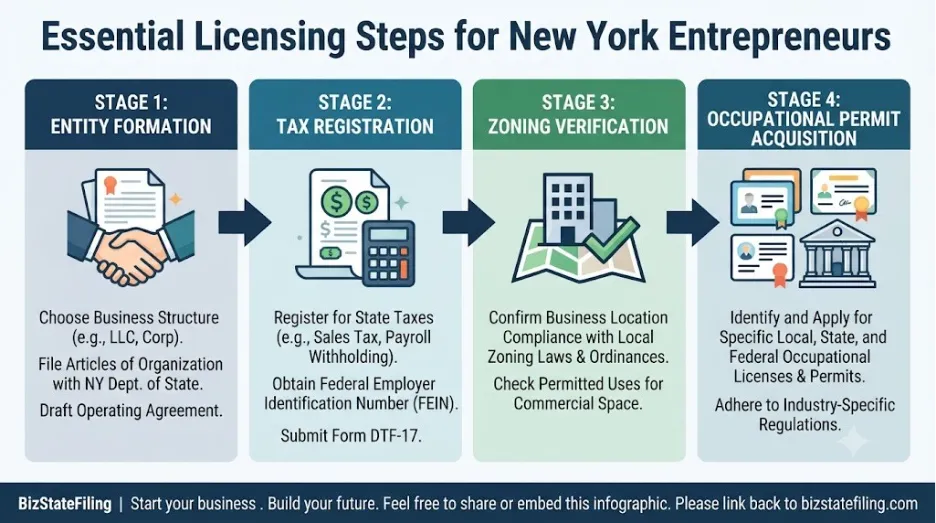
Human Capital and Regulatory Complexity
Operating a workforce in New York requires strict compliance with state labor laws and payroll taxes. Whether you have one employee or hundreds, you mustregisterfor unemployment and payroll taxes. Founders often rely on a salary to hourly conversion helper to ensure their payrollremainsaccurateand compliant with the latest wage standards.
Beyond basic payroll, some industries require mandatory background checks and fingerprinting for employees.Failing to performthese checks can jeopardize your license tooperatein sensitive sectors like education, healthcare, or financial services.
The Role of Business Intermediaries
Many business owners find the regulatory environment so dense that they hire consultants. Intermediaries who specialize in business guides can provide a roadmap, helping you avoid common pitfalls. While this adds to your startup costs, the price of an error, such as an unpermitted operation or a violation of local zoning ordinances, can be far higher.
If you are a serial entrepreneur or are looking to expand, the investment in professional compliance guidancepaysitself in avoided fines and accelerated timetomarket. The goal is to reach a state where you are proactivelymonitoringyour compliance status, rather than reacting to notices of violation.
Detailed Cost Breakdown Table
The following table provides an estimated look at the financial commitmentrequiredfor various licensing and compliance activities.
|
Cost Category |
Typical Frequency |
Responsibility |
Strategic Approach |
|
State Entity Filing |
Onetime |
Founder |
Online Portal |
|
Sales Tax Permit |
Permanent |
Finance Lead |
Dept of Taxation |
|
Local Business Tax |
Annual |
Operations Lead |
City Clerk |
|
Industry License |
Biennial |
Facility Director |
State Agency |
|
Zoning/Occupancy |
Onetime |
General Counsel |
Local Planning |
|
Safety Certification |
Annual |
HR Department |
Regulatory Board |
|
Registered Agent |
Recurring |
Legal Lead |
Compliance Agency |
|
Privacy Audit |
Quarterly |
IT Coordinator |
Internal Review |
|
Waste Management |
Monthly |
Ops Manager |
Vendor Contract |
|
Insurance Premiums |
Annual |
Business Owner |
Brokerage Firm |
Comprehensive Compliance Planning and Maintenance
To truly master the New York regulatory environment, you must view compliance as a living process. It starts with the business compliance checklist that covers every state and federal requirement, but it must evolve alongside your company. Many successful firmsestablishan internal audit schedule. By reviewing your licenses and permits on a quarterly basis, you ensure that you are never surprised byan expirationnotice or an unexpected audit from a municipal inspector.
Building a culture of compliance within your teamisimportant. When employees understand the regulatorystakesespecially in sectors like healthcare, food service, orconstruction,they are more likely to flag potential issues before they become formal violations. Providing your managers with access to industryspecific forms library can empower them to manage their own departmental compliance, such as keeping up with health department codes or safety inspections, without waiting for the owner to intervene.
NavigatingMultiJurisdictionalComplexity
Operating across multiple counties in New York is significantly more difficult thanmaintaininga single location. Each county, and often each city within that county, has its own unique set of business tax receipts and signage ordinances. For instance,operatinga retail store in ahighdensityurban environment requires compliance withtransitrelatedpermits that a warehouse or a manufacturing facility in an industrial park would neverencounter.
When you look for best cities for business , do not look solely at tax incentives. Consider the administrative ease of doing business. Some municipalities have invested heavily in digital portals for permit management, while others still requirepaperbasedfilings that can add weeks to yourproject'stimeline. A startabusiness strategy that ignores the reality of local administrative bottlenecks is prone to failure.
Managing Intellectual Property and Professional Credentials
Beyond the physical permits, New York businesses often need to manage professional licenses.If you areoperatinga consulting firm, a law practice, or a specialized engineering firm, your employees must hold active, valid professional credentials. Failure tomaintainthese can result in the loss of your business license to offer those services.
It is helpful to keep a master list of all employees who require professional certification. Just as youmonitoryour corporate license, use the compliance calendar to track individualexpirationdates. If a key employee allows their certification to lapse, they may be legally prohibited from performing their job, creating an immediate operational crisis.
Final Strategic Overview
The regulatory landscape of New York may appear intimidating, but with a structured approach, it becomes manageable. By focusing on entity formation, industryspecific compliance, and proactive data management, you can build a resilient foundation for your enterprise. Remember toleverageprofessional tools for tracking and remain diligent about local ordinances in your specific county. Your success depends on your ability to treat compliance as a core business function rather than a chore. Stay updated, keep your records pristine, and consult with professionals when navigating complexmultijurisdictionalrequirements.
Frequently Asked Questions
1.Is there a single, universal business license in New York?
No, New York does not have one master license. You mustcomply withstate, county, and municipal requirements, which vary by industry and location.
2.What is a Business Tax Receipt?
A Business Tax Receipt is a permit required by many New York cities and counties to conduct business within theirjurisdiction.
3.Do I need a professional license for every industry?
Not for every industry, but many professional roles, such as contractors, real estate agents, and medical practitioners, require specializedstateissuedcertifications.
4.Is it possible tofilean LLC online in New York?
Yes, you can manage your registration through the Department of State portal or use a turnkey business formation tool to simplify the process.
5.What happens if I miss a license renewal deadline?
Missing a deadline often results in late fees and interest. Persistent failure to comply can lead to the revocation of your authority tooperate.
6.How do I check zoning requirements before leasing?
Contact the city or county zoning department where the property islocatedto ensure your intended business activities arepermittedat that address.
7.Dohomebasedbusinesses need a license?
Yes,homebasedbusinesses aregenerally subjectto the same local business tax and zoning rules as commercial storefronts.
8.Does a sales tax permit apply to all services?
No, it typically applies to the sale of tangiblepersonal propertyand certain specified taxable services.Consult withthe New York Department of Taxation and Finance.
9.Can a registered agent help with license renewals?
A registered agent is primarily for service of process, but many professional agencies offer ongoing compliance services to track your deadlines.
10.How should I prepare for a regulatory audit?
Maintain a comprehensive, central folder for all your permits, licenses, and filings, and ensure all your contact details are kept up to date.
 Perplexity
 Claude
 Grok
Grok